Contents
Articles
2026
2025
- Google Play Protect is now the custom DPC gatekeeper, and everyone is a threat by default
- 12 deliveries of AE-mas (What shipped in Android Enterprise in 2025)
- The 12 AE requests of Christmas (2025 Edition)
- RCS Archival and you: clearing up the misconceptions
- Device Trust from Android Enterprise: What it is and how it works (hands-on)
- Android developer verification: what this means for consumers and enterprise
- AMAPI finally supports direct APK installation, this is how it works
- The Android Management API doesn't support pulling managed properties (config) from app tracks. Here's how to work around it
- Hands-on with CVE-2025-22442, a work profile sideloading vulnerability affecting most Android devices today
- AAB support for private apps in the managed Google Play iFrame is coming, take a first look here
- What's new (so far) for enterprise in Android 16
2024
- Android 15: What's new for enterprise?
- How Goto's acquisition of Miradore is eroding a once-promising MDM solution
- Google Play Protect no longer sends sideloaded applications for scanning on enterprise-managed devices
- Mobile Pros is moving to Discord
- Avoid another CrowdStrike takedown: Two approaches to replacing Windows
- Introducing MANAGED SETTINGS
- I'm joining NinjaOne
- Samsung announces Knox SDK restrictions for Android 15
- What's new (so far) for enterprise in Android 15
- Google quietly introduces new quotas for unvalidated AMAPI use
- What is Play Auto Install (PAI) in Android and how does it work?
- AMAPI publicly adds support for DPC migration
- How do Android devices become certified?
2023
- Mute @channel & @here notifications in Slack
- A guide to raising better support requests
- Ask Jason: How should we manage security and/or OS updates for our devices?
- Pixel 8 series launches with 7 years of software support
- Android's work profile behaviour has been reverted in 14 beta 5.3
- Fairphone raises the bar with commitment to Android updates
- Product files: The DoorDash T8
- Android's work profile gets a major upgrade in 14
- Google's inactive account policy may not impact Android Enterprise customers
- Product files: Alternative form factors and power solutions
- What's new in Android 14 for enterprise
- Introducing Micro Mobility
- Android Enterprise: A refresher
2022
- What I'd like to see from Android Enterprise in 2023
- Thoughts on Android 12's password complexity changes
- Google Play target API requirements & impact on enterprise applications
- Sunsetting Discuss comment platform
- Google publishes differences between Android and Android Go
- Android Go & EMM support
- Relaunching bayton.org
- AER dropped the 3/5 year update mandate with Android 11, where are we now?
- I made a bet with Google (and lost)
2020
- Product files: Building Android devices
- Google announce big changes to zero-touch
- VMware announces end of support for Device Admin
- Google launch the Android Enterprise Help Community
- Watch: An Android Enterprise discussion with Hypergate
- Listen again: BM podcast #144 - Jason Bayton & Russ Mohr talk Android!
- Google's Android Management API will soon support COPE
- Android Enterprise in 11: Google reduces visibility and control with COPE to bolster privacy.
- The decade that redefined Android in the enterprise
2019
- Why Intune doesn't support Android Enterprise COPE
- VMware WS1 UEM 1908 supports Android Enterprise enrolments on closed networks and AOSP devices
- The Bayton 2019 Android Enterprise experience survey
- Android Enterprise Partner Summit 2019 highlights
- The Huawei ban and Enterprise: what now?
- Dabbling with Android Enterprise in Q beta 3
- Why I moved from Google WiFi to Netgear Orbi
- I'm joining Social Mobile as Director of Android Innovation
- Android Enterprise in Q/10: features and clarity on DA deprecation
- MWC 2019: Mid-range devices excel, 5G everything, form-factors galore and Android Enterprise
- UEM tools managing Android-powered cars
- Joining the Android Enterprise Experts community
- February was an interesting month for OEMConfig
- Google launch Android Enterprise Recommended for Managed Service Providers
- Migrating from Windows 10 Mobile? Here's why you should consider Android
- AER expands: Android Enterprise Recommended for EMMs
- What I'd like to see from Android Enterprise in 2019
2018
- My top Android apps in 2018
- Year in review: 2018
- MobileIron Cloud R58 supports Android Enterprise fully managed devices with work profiles
- Hands on with the Huawei Mate 20 Pro
- Workspace ONE UEM 1810 introduces support for Android Enterprise fully managed devices with work profiles
- G Suite no longer prevents Android data leakage by default
- Live: Huawei Mate series launch
- How to sideload the Digital Wellbeing beta on Pie
- How to manually update the Nokia 7 Plus to Android Pie
- Hands on with the BQ Aquaris X2 Pro
- Hands on with Sony OEMConfig
- The state of Android Enterprise in 2018
- BYOD & Privacy: Don’t settle for legacy Android management in 2018
- Connecting two Synologies via SSH using public and private key authentication
- How to update Rsync on Mac OS Mojave and High Sierra
- Intune gains support for Android Enterprise COSU deployments
- Android Enterprise Recommended: HMD Global launch the Nokia 3.1 and Nokia 5.1
- Android Enterprise Partner Summit 2018 highlights
- Live: MobileIron LIVE! 2018
- Android Enterprise first: AirWatch 9.4 lands with a new name and focus
- Live: Android Enterprise Partner Summit 2018
- Samsung, Oreo and an inconsistent Android Enterprise UX
- MobileIron launch Android Enterprise work profiles on fully managed devices
- Android P demonstrates Google's focus on the enterprise
- An introduction to managed Google Play
- MWC 2018: Android One, Oreo Go, Android Enterprise Recommended & Android Enterprise
- Enterprise ready: Google launch Android Enterprise Recommended
2017
- Year in review: 2017
- Google is deprecating device admin in favour of Android Enterprise
- Hands on with the Sony Xperia XZ1 Compact
- Moto C Plus giveaway
- The state of Android Enterprise in 2017
- Samsung launched a Note 8 for enterprise
- MobileIron officially supports Android Enterprise QR code provisioning
- Android zero-touch enrolment has landed
- MobileIron unofficially supports QR provisioning for Android Enterprise work-managed devices, this is how I found it
- Hands on with the Nokia 3
- Experimenting with clustering and data replication in Nextcloud with MariaDB Galera and SyncThing
- Introducing documentation on bayton.org
- Goodbye Alexa, Hey Google: Hands on with the Google Home
- Restricting access to Exchange ActiveSync
- What is Mobile Device Management?
- 8 tips for a successful EMM deployment
- Long-term update: the fitlet-RM, a fanless industrial mini PC by Compulab
- First look: the FreedomPop V7
- Vault7 and the CIA: This is why we need EMM
- What is Android Enterprise (Android for Work) and why is it used?
- Introducing night mode on bayton.org
- What is iOS Supervision and why is it used?
- Hands on with the Galaxy TabPro S
- Introducing Nextcloud demo servers
- Part 4 - Project Obsidian: Obsidian is dead, long live Obsidian
2016
- My top Android apps 2016
- Hands on with the Linx 12V64
- Wandera review 2016: 2 years on
- Deploying MobileIron 9.1+ on KVM
- Hands on with the Nextcloud Box
- How a promoted tweet landed me on Finnish national news
- Using RWG Mobile for simple, cross-device centralised voicemail
- Part 3 – Project Obsidian: A change, data migration day 1 and build day 2
- Hands on: fitlet-RM, a fanless industrial mini PC by Compulab
- Part 2 - Project Obsidian: Build day 1
- Part 1 - Project Obsidian: Objectives & parts list
- Part 0 - Project Obsidian: Low power NAS & container server
- 5 Android apps improving my Chromebook experience
- First look: Android apps on ChromeOS
- Competition: Win 3 months of free VPS/Container hosting - Closed!
- ElasticHosts review
- ElasticHosts: Cloud Storage vs Folders, what's the difference?
- Adding bash completion to LXD
- Android N: First look & hands-on
- Springs.io - Container hosting at container prices
- Apple vs the FBI: This is why we need MDM
- Miradore Online MDM: Expanding management with subscriptions
- Lenovo Yoga 300 (11IBY) hard drive upgrade
- I bought a Lenovo Yoga 300, this is why I'm sending it back
- Restricting access to Exchange ActiveSync
- Switching to HTTPS on WordPress
2015
2014
- Is CYOD the answer to the BYOD headache?
- BYOD Management: Yes, we can wipe your phone
- A fortnight with Android Wear: LG G Watch review
- First look: Miradore Online free MDM
- Hands on: A weekend with Google Glass
- A month with Wandera Mobile Gateway
- Final thoughts: Dell Venue Pro 11 (Atom)
- Thoughts on BYOD
- Will 2014 bring better battery life?
- My year in review: Bayton.org
- The best purchase I've ever made? A Moto G for my father
2013
2012
- My Top Android Apps 12/12
- The Nexus 7 saga: Resolved
- Recycling Caps Lock into something useful - Ubuntu (12.04)
- The Nexus 7 saga continues
- From Wows to Woes: Why I won't be recommending a Nexus7 any time soon.
- Nexus7: What you need to know
- Why I disabled dlvr.it links on Facebook
- HTC Sense: Changing the lockscreen icons from within ADW
2011
- Push your Google+ posts to Twitter and Facebook
- Using multiple accounts with Google.
- The "Wn-R48" (Windows on the Cr-48)
- Want a Google+ invite?
- Publishing to external sources from Google+
- Dell Streak review. The Phone/Tablet Hybrid
- BlueInput: The Bluetooth HID driver Google forgot to include
- Pushing Buzz to Twitter with dlvr.it
- Managing your social outreach with dlvr.it
- When Awe met Some. The Cr-48 and Gnome3.
- Living with Google's Cr-48 and the cloud.
- Downtime 23-25/04/2011
- Are you practising "safe surfing"?
- The Virtualbox bug: "Cannot access the kernel driver" in Windows
- Putting tech into perspective
2010
- Have a Google Buzz Christmas
- Root a G1 running Android 1.6 without recovery!
- Windows 7 display issues on old Dell desktops
- Google added the Apps flexibility we've been waiting for!
- Part I: My 3 step program for moving to Google Apps
- Downloading torrents
- Completing the Buzz experience for Google Maps Mobile
- Quicktip: Trial Google Apps
- Quicktip: Save internet images fast
- Turn your desktop 3D!
- Part III - Device not compatible - Skype on 3
- Swype not compatible? ShapeWriter!
- Don't wait, get Swype now!
- HideIP VPN. Finally!
- Google enables Wave for Apps domains
- Aspire One touch screen
- Streamline XP into Ubuntu
- Edit a PDF with Zamzar
- Google offering Gmail addresses in the UK
- Google Wave: Revolutionising blogs!
- Hexxeh's Google Chrome OS builds
- Update: Buzz on Windows Mobile
- Alternatives to Internet Explorer
- Wordress 3.0 is coming!
- Skype for WM alternatives
- Browsing on a (data) budget? Opera!
- Buzz on unsupported mobiles
- Buzz on your desktop
- What's all the Buzz?
- Part II: Device not compatible - Skype on 3
- Part I - Device not compatible - Skype on 3
- Dreamscene on Windows 7
- Free Skype with 3? There's a catch..
Change log
Introducing AMAPI Commander: converse with your Android estate
Contents
If you manage or support an estate of Android devices, you already know the pain. Getting a straightforward answer about your estate typically means logging into a console, clicking through several screens, exporting a report, and wrangling it into something useful. Need to know how many devices are running an outdated security patch? That's a ticket to IT, a scheduled report, or half an afternoon with spreadsheets. The data is there, locked behind tools that only a handful of people know how to operate.
I've spent years building resources around Android Enterprise, from MANAGED INFO and MANAGED SETTINGS to the system apps database, QR code generator, and my documentation - all have become popular utilities for the community. AMAPI Commander is the next step in that journey of learning more about the succulent underbelly of the Android world: a platform that lets you query your entire Android device estate by simply asking questions in plain English.
As a disclaimer, if you're an organisation managing Android devices with a commercial EMM vendor, this platform is not for you. EMM vendors own and control their Google Cloud Projects, and wouldn't grant the access needed for organisations to leverage AMAPI Commander.
Think of this more as a technical preview of what your EMM vendor could eventually integrate into their own stack.
A quick refresher on AMAPI
#Google's Android Management API (AMAPI) is the cloud-based API that underpins modern Android Enterprise device management. It is the engine behind many EMM solutions today, handling everything from device enrolment and policy enforcement to application distribution and compliance reporting. If your organisation uses Workspace ONE, Intune, NinjaOne, Applivery, or any other AMAPI-enabled EMM, your device estate data may already flow through this platform.
AMAPI Commander doesn't replace your EMM. It doesn't even sit alongside it.. but where feasible, it can offer you a new way to access and query the data AMAPI already holds about your devices, policies, and enterprise configuration, when integrated into the appropriate Google Cloud Project.
The Model Context Protocol: why it matters
#The bit that makes this technically interesting, and I'd argue forward-looking, is the Model Context Protocol (MCP).
MCP is an open standard, originally developed by Anthropic and now maintained under the Linux Foundation, that defines how AI models connect to external tools and data sources. Think of it as a universal plug: rather than building bespoke integrations for every AI assistant on the market, you expose your tools via MCP and any compatible model (ChatGPT, Claude, Gemini, or whatever comes next) can use them.
The obvious opportunity here is for EMM solutions. Under almost all circumstances, customers don't have direct access to the Google Cloud project that backs their device management; it's the EMM that owns and operates the AMAPI project on their behalf. That makes EMMs the natural home for an MCP integration: they could expose estate data from their own AMAPI projects through their platforms, letting customers query their device estate through any MCP-aware AI assistant without needing to know or care about the underlying API.
AMAPI Commander is something of an outlier in this regard. It implements an MCP server that bridges AI models directly to Google's Android Management API, and opens that up to anyone with an AMAPI Google Cloud project, whether that's an EMM vendor, a managed service provider, or an organisation that manages its own AMAPI project directly (being mindful of the permissible usage limitations).
For EMMs and platform vendors thinking about AI strategy, MCP offers a protocol-level integration point that avoids locking into a single vendor's AI ecosystem. Today in AMAPI Commander it powers the built-in assistant. But the same approach could power a custom GPT, a Claude agent, or an internal tool an engineering team builds, all against the same secure, rate-limited interface.
How AMAPI offers MCP
#Google publishes an official MCP server for the Android Management API. Rather than requiring traditional server-to-server integration - where a developer writes code to authenticate, construct REST requests, parse JSON responses, and handle pagination - the AMAPI MCP server exposes the API as a set of discrete, self-describing tools that an AI model can call directly during a conversation.
This is a fundamentally different interaction model. With a conventional API integration, a developer builds a client that knows exactly which endpoints to call and how to interpret the responses. With MCP, the model reads tool definitions at runtime - names, descriptions, parameter schemas - and reasons about which tools to invoke based on a natural-language prompt. There's no pre-built client logic; the model decides the call sequence on the fly.
The AMAPI MCP server currently exposes nine read-only tools spanning the core AMAPI resources:
Enterprises - list_enterprises retrieves all enterprises accessible within a Google Cloud project, while get_enterprise returns the full configuration for a single enterprise including contact details, display name, and enabled features.
Devices - list_devices returns a paginated device inventory for an enterprise, covering hardware specs, OS version, compliance state, last sync time, applied policy, enrolment info, hardware identifiers, and security posture.. and more. get_device drills into a single device record with this information.
Policies - list_policies enumerates all policies defined within an enterprise. get_policy returns the complete single policy configuration: password requirements, app install rules, network settings, and compliance rules, and so on.
Applications - get_application pulls application metadata from managed Google Play, including title, permissions, available versions, and managed configurations. It supports a languageCode parameter for localised results.
Web apps - list_web_apps returns all web apps published to the managed Google Play iFrame, and get_web_app provides the configuration for a specific web app including display mode, URL, and icon.
Every tool is strictly read-only. There are no create, update, or delete operations. The model cannot modify policies, wipe devices, or push applications. The data returned is the same data you'd get from the equivalent AMAPI REST calls, but the path to it is entirely different: instead of a developer writing integration code, an LLM interprets a question, selects the relevant tools, constructs the parameters, and synthesises the results into a human-readable answer.
Where a traditional integration might require dozens of lines of code to list devices, filter by OS version, and format a report, an MCP-connected model handles that in a single conversational turn - chaining list_devices, inspecting the returned fields, and summarising the output without any bespoke client logic.
What AMAPI Commander does
#AMAPI Commander is a multi-tenant web application that sits between the user and AMAPI. Rather than navigating dashboards or writing API calls, you ask the platform a question, and it returns an answer in seconds.
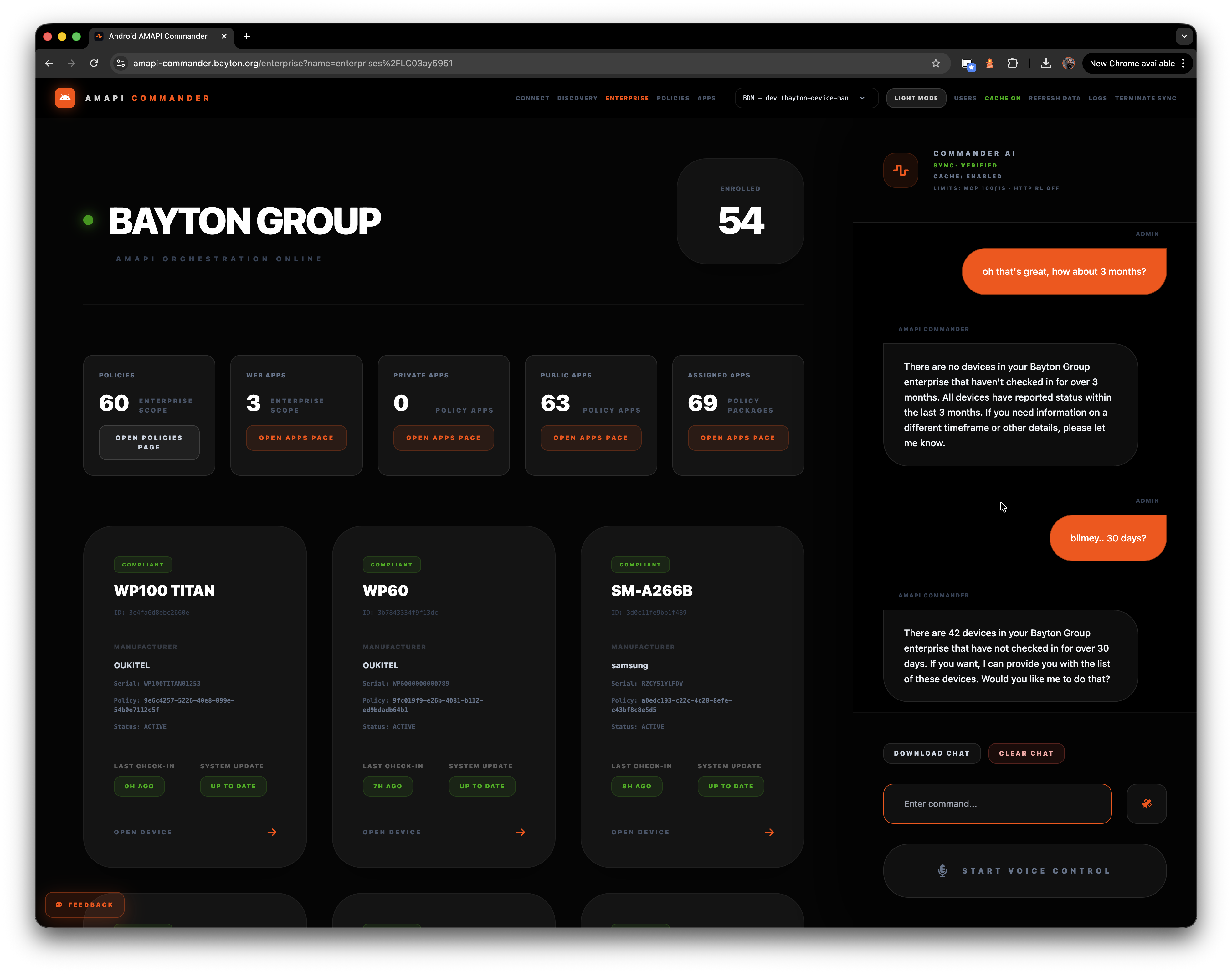
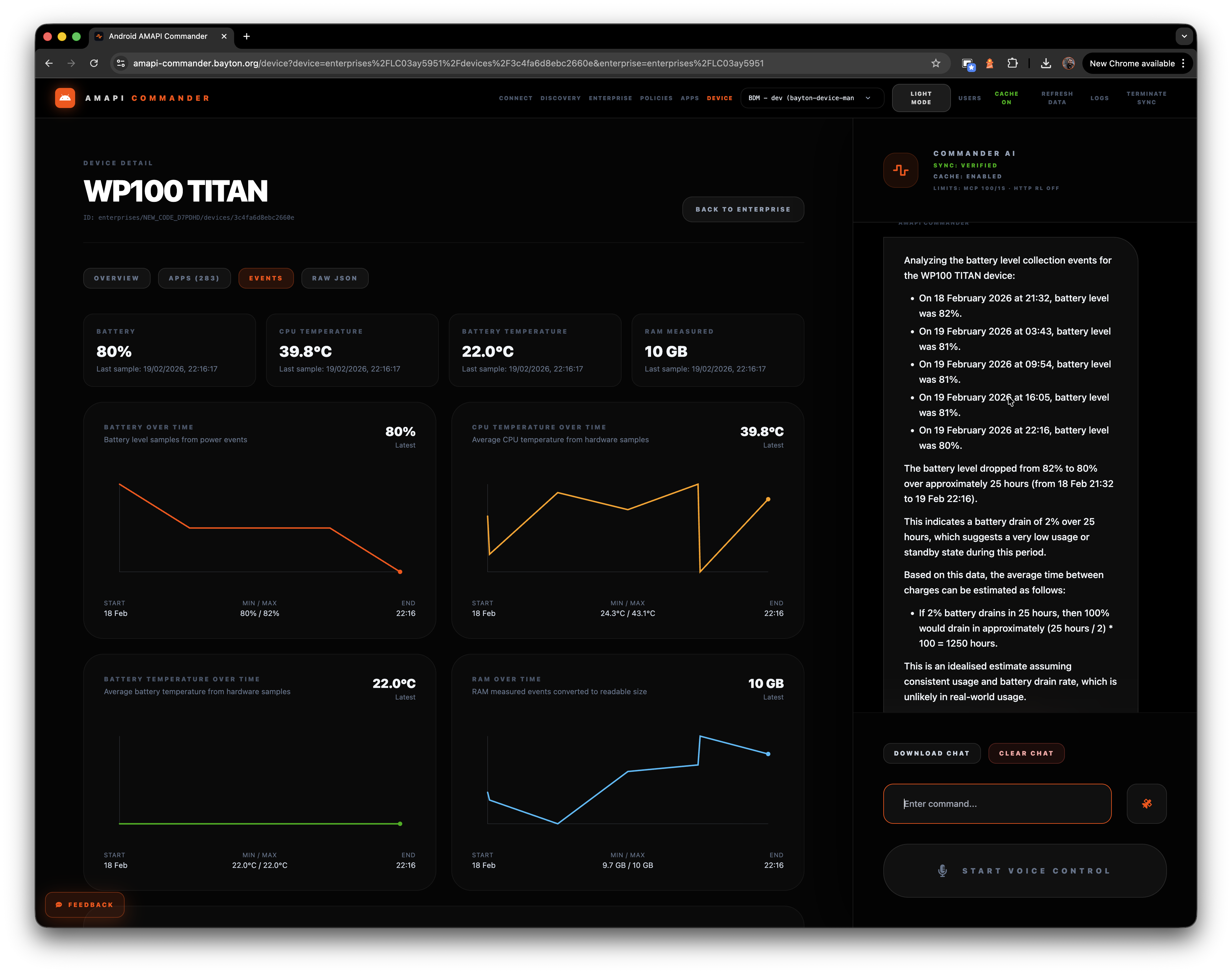
Behind the scenes, an AI assistant powered by OpenAI translates your query into structured API calls against your Google Cloud project, retrieves the relevant data, and presents the results in a format that makes sense. It supports both text and voice interaction, background processing for large estate queries, and intelligent caching so repeated questions don't burn through your Google API quota.
Why OpenAI? I'm most familiar with it, and as such was much easier to set the requirements, anticipate the behaviours, and mould it into what I wanted to achieve much faster.
What you can ask
#The platform exposes the nine tools that map directly to AMAPI's core resources. Here are some practical examples of what that looks like in conversation:
- Enterprises: "List all enterprises in my project" or "Show me the details for enterprise LC012345" - useful for managed service providers overseeing multiple customer estates.
- Devices: "How many devices are enrolled?", "Show me all devices running Android 13 or older", or "What's the compliance status of device XYZ?" - the bread and butter for estate oversight.
- Policies: "What policies are currently active?" or "Show me the configuration for the BYOD policy" - helpful when auditing what's actually applied versus what's documented.
- Applications: "What version of Chrome is deployed across the estate?" or "Show me the details for com.google.android.apps.work.clouddpc" - quick lookups that would normally require a Play Store console detour.
- Web apps: "List all web apps published to managed Google Play" or "Show me the configuration for our intranet web app" - niche, but genuinely useful when you need it.
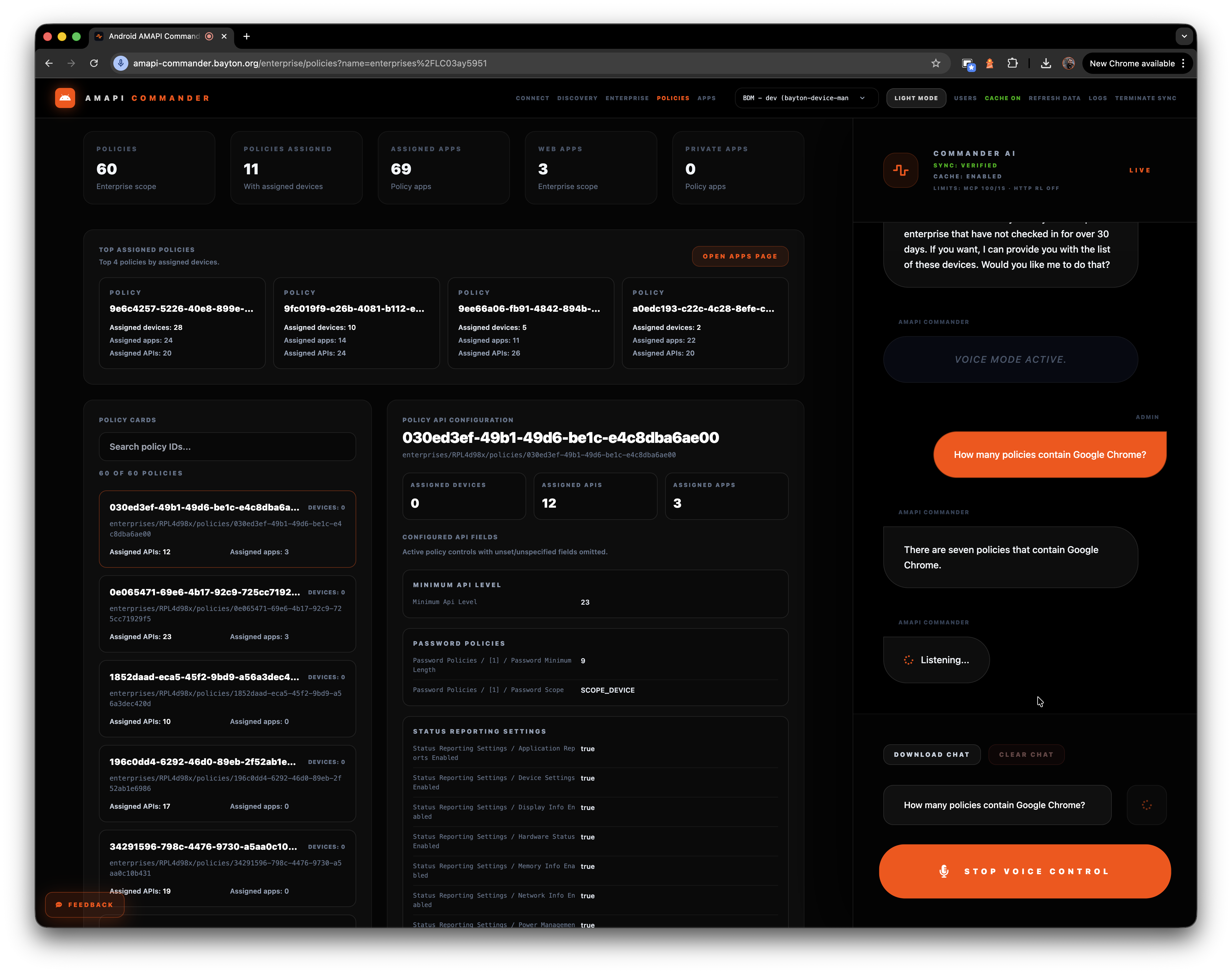
These aren't canned queries. You phrase the question however you like, and the assistant works out which tools to call, in what order, and how to combine the results. Ask it to compare compliance across two policies, or to summarise which devices haven't synced in the last 30 days, and it will chain the relevant API calls together.
I will pause here to say it's not all out-of-the-box-LLM. Without gates and a bit of logic to help the LLM decide which MCP tool to use (and always use the MCP tool) the responses were originally far less succinct. There's definitely some orchestration, but I've tried to keep it light.
Built for multi-tenant from day one
#Each workspace operates as an isolated tenant with its own Google Cloud project credentials, encrypted API keys, user memberships, and role-based access control. Workspace owners manage secrets, admins handle invitations and members, and members get read access to estate data. Data is isolated at every layer: storage keys, cache entries, and audit logs are all scoped either per workspace, or per user.
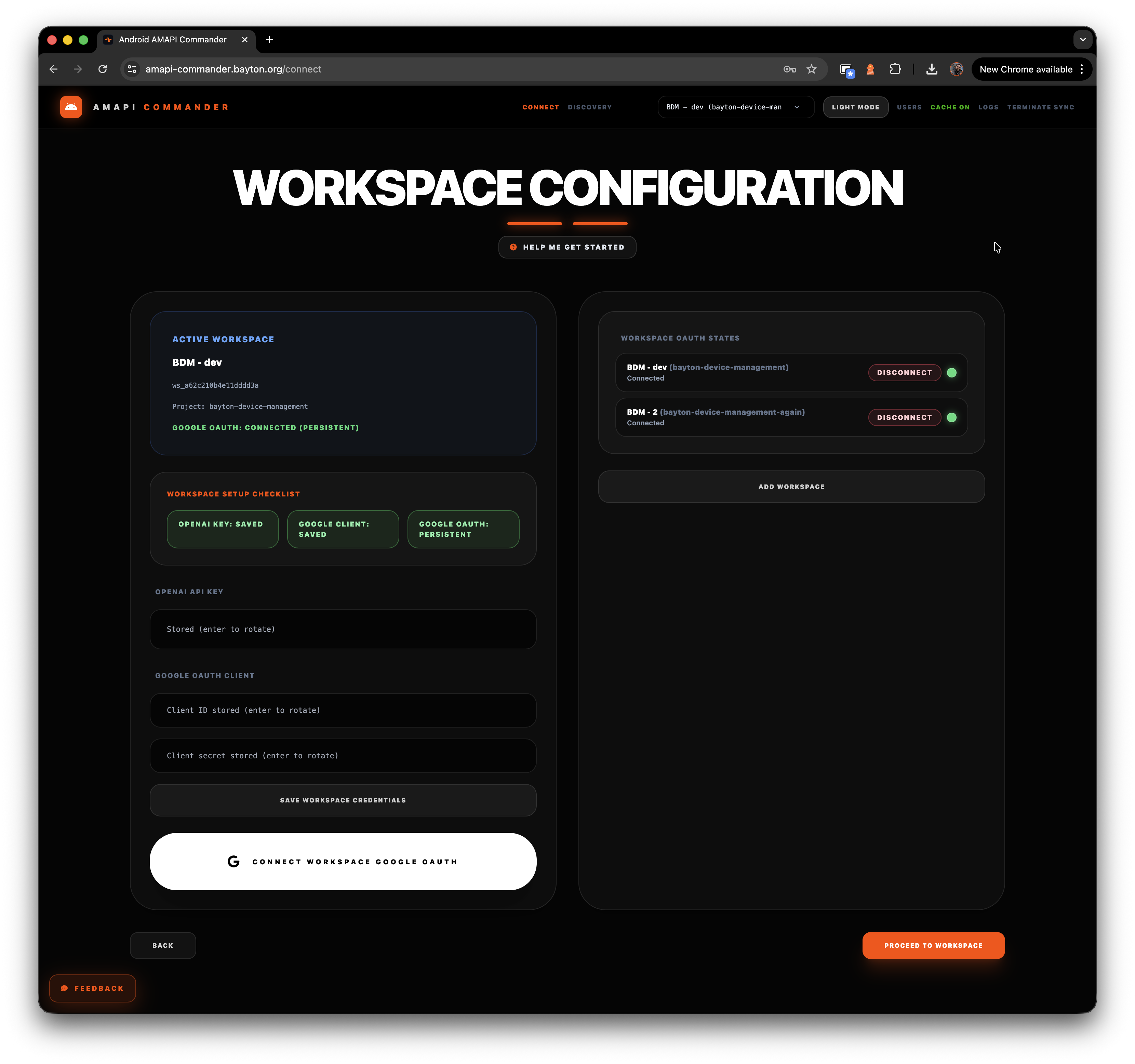
On the security side, credentials are encrypted at rest with AES-256-GCM (the same standard used across banking and government), and the platform never returns encrypted values to the client. Authentication supports both Google OAuth for authorising Google Cloud Project access, while passwordless magic links handle access to AMAPI Commander's UI. There's also a comprehensive audit trail for privileged operations. The architecture has been through multiple rounds of security auditing, and the full technical detail is documented in the Technical Whitepaper for those who want to kick the tyres.
Who is this for?
#AMAPI Commander is a reference implementation, not an end-customer product. It's built for anyone in the Android Enterprise ecosystem who has direct access to an AMAPI-enabled Google Cloud project:
- EMM vendors exploring how conversational AI and MCP can surface estate data — a working example of the experience they could offer their own customers.
- Managed service providers who operate their own AMAPI projects perhaps via on-prem solutions on behalf of an EMM, and want a more accessible way to query the data they already manage.
- Technical partners and developers integrating with AMAPI who want to see how MCP tools map to the API in practice.
Organisations managing devices through a commercial EMM won't have access to the underlying Google Cloud project — their vendor owns that. AMAPI Commander is a glimpse of what's possible when that data is made conversational, and an invitation for vendors to bring something similar to their own platforms.
What AMAPI Commander isn't
#To reiterate for absolute clarity: this is not an EMM solution. It doesn't push policies or provision devices. What it does is make the data your EMM already manages through AMAPI accessible, queryable, and useful, without requiring everyone on the team to understand API documentation or navigate a management console.
What's next
#AMAPI Commander is in pre-production, and I'm actively working through a heap of hardening items, including RBAC against specific enterprises within a workspace to enable limited project access for members. All of this to come before a wider release, so the platform is presently invite-only. If you're interested in early access, want to see a demo, or simply want to chat about the approach, I'd love to hear from you!
In the meantime, have a look at the Getting Started guide, or dive into the Technical Whitepaper for the full architectural detail.
Articles
2026
2025
- Google Play Protect is now the custom DPC gatekeeper, and everyone is a threat by default
- 12 deliveries of AE-mas (What shipped in Android Enterprise in 2025)
- The 12 AE requests of Christmas (2025 Edition)
- RCS Archival and you: clearing up the misconceptions
- Device Trust from Android Enterprise: What it is and how it works (hands-on)
- Android developer verification: what this means for consumers and enterprise
- AMAPI finally supports direct APK installation, this is how it works
- The Android Management API doesn't support pulling managed properties (config) from app tracks. Here's how to work around it
- Hands-on with CVE-2025-22442, a work profile sideloading vulnerability affecting most Android devices today
- AAB support for private apps in the managed Google Play iFrame is coming, take a first look here
- What's new (so far) for enterprise in Android 16
2024
- Android 15: What's new for enterprise?
- How Goto's acquisition of Miradore is eroding a once-promising MDM solution
- Google Play Protect no longer sends sideloaded applications for scanning on enterprise-managed devices
- Mobile Pros is moving to Discord
- Avoid another CrowdStrike takedown: Two approaches to replacing Windows
- Introducing MANAGED SETTINGS
- I'm joining NinjaOne
- Samsung announces Knox SDK restrictions for Android 15
- What's new (so far) for enterprise in Android 15
- Google quietly introduces new quotas for unvalidated AMAPI use
- What is Play Auto Install (PAI) in Android and how does it work?
- AMAPI publicly adds support for DPC migration
- How do Android devices become certified?
2023
- Mute @channel & @here notifications in Slack
- A guide to raising better support requests
- Ask Jason: How should we manage security and/or OS updates for our devices?
- Pixel 8 series launches with 7 years of software support
- Android's work profile behaviour has been reverted in 14 beta 5.3
- Fairphone raises the bar with commitment to Android updates
- Product files: The DoorDash T8
- Android's work profile gets a major upgrade in 14
- Google's inactive account policy may not impact Android Enterprise customers
- Product files: Alternative form factors and power solutions
- What's new in Android 14 for enterprise
- Introducing Micro Mobility
- Android Enterprise: A refresher
2022
- What I'd like to see from Android Enterprise in 2023
- Thoughts on Android 12's password complexity changes
- Google Play target API requirements & impact on enterprise applications
- Sunsetting Discuss comment platform
- Google publishes differences between Android and Android Go
- Android Go & EMM support
- Relaunching bayton.org
- AER dropped the 3/5 year update mandate with Android 11, where are we now?
- I made a bet with Google (and lost)
2020
- Product files: Building Android devices
- Google announce big changes to zero-touch
- VMware announces end of support for Device Admin
- Google launch the Android Enterprise Help Community
- Watch: An Android Enterprise discussion with Hypergate
- Listen again: BM podcast #144 - Jason Bayton & Russ Mohr talk Android!
- Google's Android Management API will soon support COPE
- Android Enterprise in 11: Google reduces visibility and control with COPE to bolster privacy.
- The decade that redefined Android in the enterprise
2019
- Why Intune doesn't support Android Enterprise COPE
- VMware WS1 UEM 1908 supports Android Enterprise enrolments on closed networks and AOSP devices
- The Bayton 2019 Android Enterprise experience survey
- Android Enterprise Partner Summit 2019 highlights
- The Huawei ban and Enterprise: what now?
- Dabbling with Android Enterprise in Q beta 3
- Why I moved from Google WiFi to Netgear Orbi
- I'm joining Social Mobile as Director of Android Innovation
- Android Enterprise in Q/10: features and clarity on DA deprecation
- MWC 2019: Mid-range devices excel, 5G everything, form-factors galore and Android Enterprise
- UEM tools managing Android-powered cars
- Joining the Android Enterprise Experts community
- February was an interesting month for OEMConfig
- Google launch Android Enterprise Recommended for Managed Service Providers
- Migrating from Windows 10 Mobile? Here's why you should consider Android
- AER expands: Android Enterprise Recommended for EMMs
- What I'd like to see from Android Enterprise in 2019
2018
- My top Android apps in 2018
- Year in review: 2018
- MobileIron Cloud R58 supports Android Enterprise fully managed devices with work profiles
- Hands on with the Huawei Mate 20 Pro
- Workspace ONE UEM 1810 introduces support for Android Enterprise fully managed devices with work profiles
- G Suite no longer prevents Android data leakage by default
- Live: Huawei Mate series launch
- How to sideload the Digital Wellbeing beta on Pie
- How to manually update the Nokia 7 Plus to Android Pie
- Hands on with the BQ Aquaris X2 Pro
- Hands on with Sony OEMConfig
- The state of Android Enterprise in 2018
- BYOD & Privacy: Don’t settle for legacy Android management in 2018
- Connecting two Synologies via SSH using public and private key authentication
- How to update Rsync on Mac OS Mojave and High Sierra
- Intune gains support for Android Enterprise COSU deployments
- Android Enterprise Recommended: HMD Global launch the Nokia 3.1 and Nokia 5.1
- Android Enterprise Partner Summit 2018 highlights
- Live: MobileIron LIVE! 2018
- Android Enterprise first: AirWatch 9.4 lands with a new name and focus
- Live: Android Enterprise Partner Summit 2018
- Samsung, Oreo and an inconsistent Android Enterprise UX
- MobileIron launch Android Enterprise work profiles on fully managed devices
- Android P demonstrates Google's focus on the enterprise
- An introduction to managed Google Play
- MWC 2018: Android One, Oreo Go, Android Enterprise Recommended & Android Enterprise
- Enterprise ready: Google launch Android Enterprise Recommended
2017
- Year in review: 2017
- Google is deprecating device admin in favour of Android Enterprise
- Hands on with the Sony Xperia XZ1 Compact
- Moto C Plus giveaway
- The state of Android Enterprise in 2017
- Samsung launched a Note 8 for enterprise
- MobileIron officially supports Android Enterprise QR code provisioning
- Android zero-touch enrolment has landed
- MobileIron unofficially supports QR provisioning for Android Enterprise work-managed devices, this is how I found it
- Hands on with the Nokia 3
- Experimenting with clustering and data replication in Nextcloud with MariaDB Galera and SyncThing
- Introducing documentation on bayton.org
- Goodbye Alexa, Hey Google: Hands on with the Google Home
- Restricting access to Exchange ActiveSync
- What is Mobile Device Management?
- 8 tips for a successful EMM deployment
- Long-term update: the fitlet-RM, a fanless industrial mini PC by Compulab
- First look: the FreedomPop V7
- Vault7 and the CIA: This is why we need EMM
- What is Android Enterprise (Android for Work) and why is it used?
- Introducing night mode on bayton.org
- What is iOS Supervision and why is it used?
- Hands on with the Galaxy TabPro S
- Introducing Nextcloud demo servers
- Part 4 - Project Obsidian: Obsidian is dead, long live Obsidian
2016
- My top Android apps 2016
- Hands on with the Linx 12V64
- Wandera review 2016: 2 years on
- Deploying MobileIron 9.1+ on KVM
- Hands on with the Nextcloud Box
- How a promoted tweet landed me on Finnish national news
- Using RWG Mobile for simple, cross-device centralised voicemail
- Part 3 – Project Obsidian: A change, data migration day 1 and build day 2
- Hands on: fitlet-RM, a fanless industrial mini PC by Compulab
- Part 2 - Project Obsidian: Build day 1
- Part 1 - Project Obsidian: Objectives & parts list
- Part 0 - Project Obsidian: Low power NAS & container server
- 5 Android apps improving my Chromebook experience
- First look: Android apps on ChromeOS
- Competition: Win 3 months of free VPS/Container hosting - Closed!
- ElasticHosts review
- ElasticHosts: Cloud Storage vs Folders, what's the difference?
- Adding bash completion to LXD
- Android N: First look & hands-on
- Springs.io - Container hosting at container prices
- Apple vs the FBI: This is why we need MDM
- Miradore Online MDM: Expanding management with subscriptions
- Lenovo Yoga 300 (11IBY) hard drive upgrade
- I bought a Lenovo Yoga 300, this is why I'm sending it back
- Restricting access to Exchange ActiveSync
- Switching to HTTPS on WordPress
2015
2014
- Is CYOD the answer to the BYOD headache?
- BYOD Management: Yes, we can wipe your phone
- A fortnight with Android Wear: LG G Watch review
- First look: Miradore Online free MDM
- Hands on: A weekend with Google Glass
- A month with Wandera Mobile Gateway
- Final thoughts: Dell Venue Pro 11 (Atom)
- Thoughts on BYOD
- Will 2014 bring better battery life?
- My year in review: Bayton.org
- The best purchase I've ever made? A Moto G for my father
2013
2012
- My Top Android Apps 12/12
- The Nexus 7 saga: Resolved
- Recycling Caps Lock into something useful - Ubuntu (12.04)
- The Nexus 7 saga continues
- From Wows to Woes: Why I won't be recommending a Nexus7 any time soon.
- Nexus7: What you need to know
- Why I disabled dlvr.it links on Facebook
- HTC Sense: Changing the lockscreen icons from within ADW
2011
- Push your Google+ posts to Twitter and Facebook
- Using multiple accounts with Google.
- The "Wn-R48" (Windows on the Cr-48)
- Want a Google+ invite?
- Publishing to external sources from Google+
- Dell Streak review. The Phone/Tablet Hybrid
- BlueInput: The Bluetooth HID driver Google forgot to include
- Pushing Buzz to Twitter with dlvr.it
- Managing your social outreach with dlvr.it
- When Awe met Some. The Cr-48 and Gnome3.
- Living with Google's Cr-48 and the cloud.
- Downtime 23-25/04/2011
- Are you practising "safe surfing"?
- The Virtualbox bug: "Cannot access the kernel driver" in Windows
- Putting tech into perspective
2010
- Have a Google Buzz Christmas
- Root a G1 running Android 1.6 without recovery!
- Windows 7 display issues on old Dell desktops
- Google added the Apps flexibility we've been waiting for!
- Part I: My 3 step program for moving to Google Apps
- Downloading torrents
- Completing the Buzz experience for Google Maps Mobile
- Quicktip: Trial Google Apps
- Quicktip: Save internet images fast
- Turn your desktop 3D!
- Part III - Device not compatible - Skype on 3
- Swype not compatible? ShapeWriter!
- Don't wait, get Swype now!
- HideIP VPN. Finally!
- Google enables Wave for Apps domains
- Aspire One touch screen
- Streamline XP into Ubuntu
- Edit a PDF with Zamzar
- Google offering Gmail addresses in the UK
- Google Wave: Revolutionising blogs!
- Hexxeh's Google Chrome OS builds
- Update: Buzz on Windows Mobile
- Alternatives to Internet Explorer
- Wordress 3.0 is coming!
- Skype for WM alternatives
- Browsing on a (data) budget? Opera!
- Buzz on unsupported mobiles
- Buzz on your desktop
- What's all the Buzz?
- Part II: Device not compatible - Skype on 3
- Part I - Device not compatible - Skype on 3
- Dreamscene on Windows 7
- Free Skype with 3? There's a catch..